Closer to Nomadland Than I Want to Admit
Watching Nomadland again exposed the fear beneath our slow-travel plan: not the van or the road, but being stranded when luck runs out.
I saw Nomadland when it first came out. I bought the audiobook afterward and never finished it. The movie stayed with me, but apparently not enough for me to understand why.
I watched it again the other night, and this time I understood. What I saw was what I'm afraid of.
It isn't the van, or the campgrounds, or showers where we can find them, or having our whole life packed into a vehicle.
It's being stranded.
It's something breaking when there's no money to fix it. It's reaching the point where there's nowhere else to go and nobody coming to pull you out, and discovering that the line between choosing a nomadic life and being trapped in one is thinner than you thought. The people in Nomadland keep moving, but not all movement is freedom. Sometimes you're moving because stopping would force you to admit there's nothing underneath you. That's the part that got me.
A few weeks ago I wrote that I'm not afraid of damaging the younger kids educationally by pulling them out of the system to travel. I'm a teacher. I know how much of school is real learning and how much is institutional routine, and I still believe I can build them a serious education on the road.
Money is different.
There's one major difference between our future and the lives in that movie: my retirement income should be guaranteed. Even if it isn't enough to support the version of travel I imagine, something arrives every month. We could find somewhere cheap enough to survive, stop moving, get our shit together, and build back from there. That matters. It's not a small thing.
But the world in that movie isn't as far behind me as I'd like to pretend.
In 2019, I went back to teaching because I couldn't afford to live on a city inspector's salary anymore. More accurately, I couldn't keep pretending that I could. I took a job in one of the worst districts I've ever worked in, which is saying something considering how many bad districts I've worked in.
I hated it.
The drive there every morning was soul crushing because I knew where I was going. The drive home was soul crushing because I knew I had to go back. There wasn't one dramatic event that made it unbearable. It was the accumulation of ordinary days spent somewhere I didn't want to be because I couldn't afford to leave.
That was when I finally gave the thing a name. It had nagged at me my whole adult life. I always knew what the straight math said about our budget, and I always knew I could sometimes pull it off anyway — sometimes in lame ways, like a grandmother who'd skimped her whole life bailing out her reckless grandson, sometimes by working as a carpenter's helper to get through. But on those drives in 2019, I saw the thing for what it was: terror. It had terrorized me plenty of times before. I'd just never called it by its name.
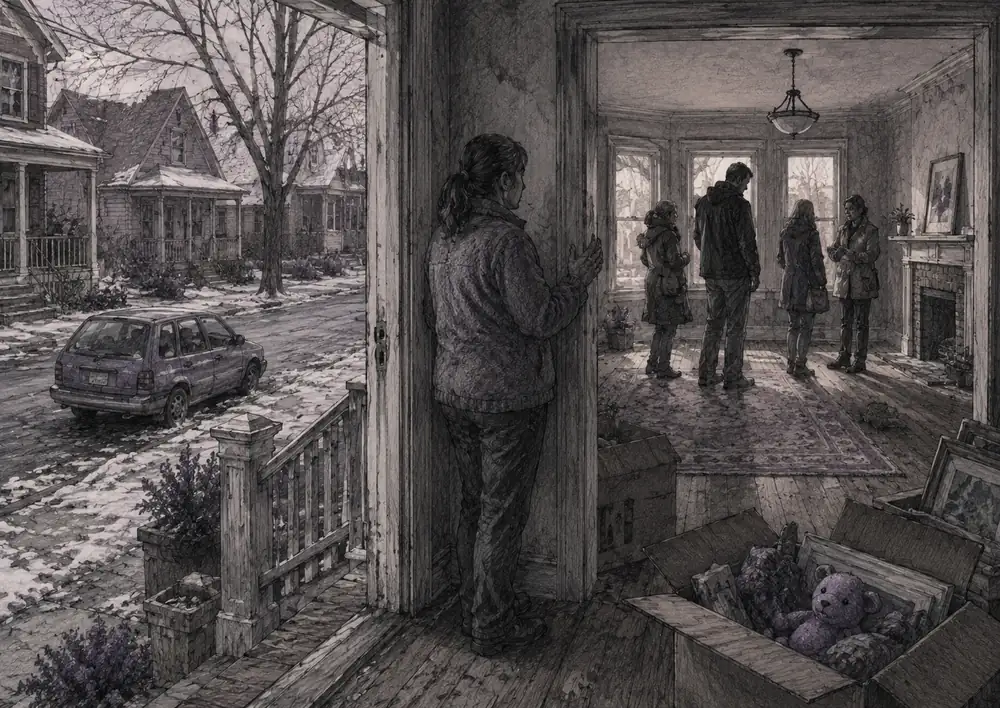
The time it came closest was the winter of 2016 and '17, after I'd walked away from teaching and badly misjudged my value to school districts, international schools, and my former corporate employers. The misjudgment was believing the doors my resume used to open were still open. We were selling our house to survive, and we'd park our little Kia down the block while strangers walked through it. Shortly after that I cashed in my retirement, yet again, so I'd be starting over — if I started again at all. I did. But that winter I learned how the deck was now stacked. I could still do the work — I could hold my own with any professional I met in daily life — but the market had stopped caring. I was competing for the minimum-wage jobs they save for seniors. Outside of teaching, or starting over from scratch in some other bullshit, there was no market for me. I was at the mercy of anyone doing the hiring.
The cliff has been there ever since. I've felt like I was standing with my back against it while life kept forcing me one small step closer — every bill, every expense narrowing the space, never knowing which step would be the one that took me over. That feeling has never completely gone away.
For a long time I was pretty cocky about my ability to survive. I'm educated. I've worked in different industries. I can learn things quickly, talk my way through situations, and usually figure out some kind of solution. I believed I could survive almost anything. Then I had a family, and the question changed: could I keep all of us alive and reasonably okay, no matter what happened?
We've been running from insolvency for almost eighteen years. I knew when I started teaching that it solved some problems and would cause others later, when I needed real grown-up money to live on. I'm in exactly the place I knew I'd be. I didn't become one of those disciplined savers who manages every dollar and writes a finance blog about it. I fucking gripped the wheel and plowed through. No major accidents yet.
But knowing where you're headed doesn't prepare you for what it feels like to live there month after month. There's never extra. Every month is another small campaign to get everything paid. Some months work because of extra-duty pay, or overtime, or a class-overage payment that arrived exactly when we needed it.
Miracles have been a regular part of our budget.
You can live that way for a surprisingly long time. You become resourceful. You learn which bills can move and which can't, how to stretch a week, how to delay a purchase and act calm while doing math in your head.
You also pay for it. You pay for it in sleep and in the low-level panic that never fully leaves. You pay for it when every broken appliance feels like a threat. You pay for it when an unexpected expense doesn't merely inconvenience you but puts the whole structure at risk. You pay for it in the part of your mind that's always waiting for the next thing to go wrong.
Our trip to Ouray was beautiful, magical in ways I'm still trying to put into words. The kids saw mountains, waterfalls, old towns, a version of America that doesn't appear from inside our regular routines. That's part of what I want for them — the country, slowly, outside the sealed box of school, work, shopping, screens, and the same roads every day.
We bought SearchingForAmerica.org because I don't just want to take them to national parks and places that photograph well. I want the beautiful America, and I want the rest of it too. The small towns. The worn-out places. The people making lives without much money or influence, who know what it means when a vehicle breaks, a job disappears, or one bad month turns into six.
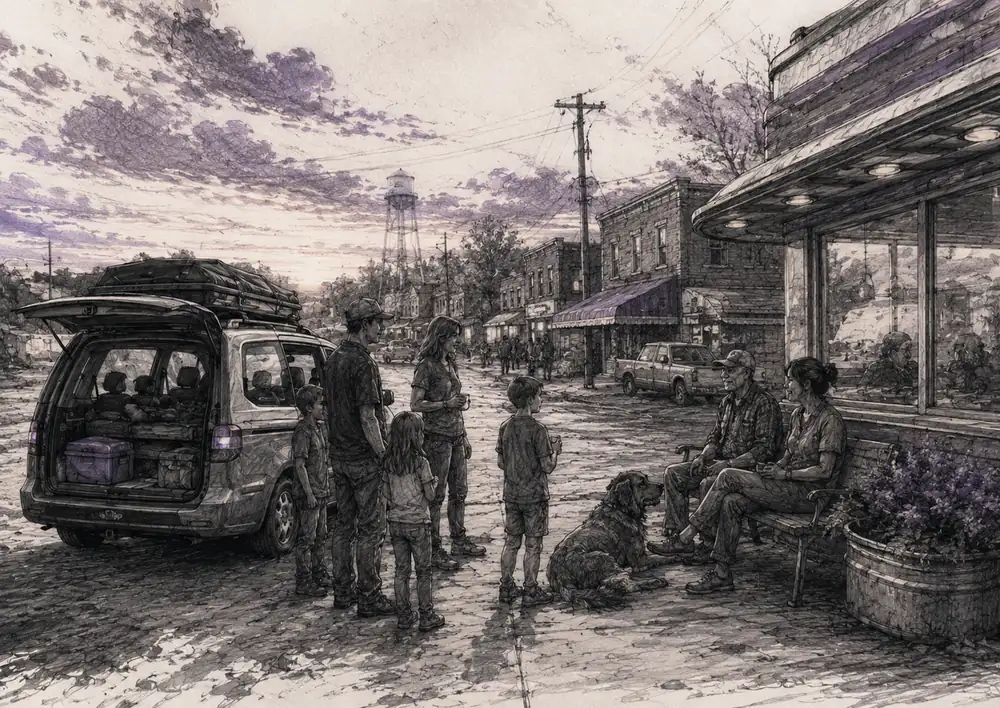
I don't want my kids looking at those people through the windshield like they're an exhibit. I want them to understand that we're the same people. Not much separates our family from the folks in that movie — a pension, some luck. The kids should know it, not as a scare tactic, not as charity tourism, but as the plain truth about where they come from.
And the pension is a schoolteacher's pension. My starts and stops, the cashed-in retirements, and the burning it down mean I'll be working until about 68 — and then, pension and Social Security combined, we can squeak out about 60% of what I'm making after tax now. I'm grateful for it. But it's 60% of a schoolteacher.
It's enough to live like nomads as long as not much goes wrong. I'm already squinting so I don't have to see what health insurance will cost. I'm already assuming big breaks on travel costs, assuming things will go well, because that's what we have to do. Sometimes that works. Sometimes we get stuck.
Maybe that's what this whole thing is really about: how much we're willing to count on luck. As long as I'm with them, part of me is fine letting luck roll. Another part says I have no business trusting my kids to luck at all. But isn't all of life luck? Am I willing to trade the world for safety?
No. Because I've realized that if I wait until I can provide what they deserve, we'll never go anywhere. So we're gonna go anyway and hope for the best. I'm not a wealthy retiree planning an extended vacation. I'm a schoolteacher trying to show two kids the country while carrying a lifetime of financial instability behind me. I understand that math now. And I understand the other math — the math of looking back at 80, if God helps me make it there and my youngest turns 21, and being crushed because we did nothing but sit where we were.
The decision doesn't remove the fear — and part of what worries me is how little the odds worry me. I've pulled off so many plans where eight out of ten definitely-not-guaranteed things had to come together — and did — that I don't flinch when the plan in front of me needs the same kind of luck. This one does. For it to work the way I imagine, eight out of ten somewhat improbable things have to break our way, and my instinct is to shrug and start driving.
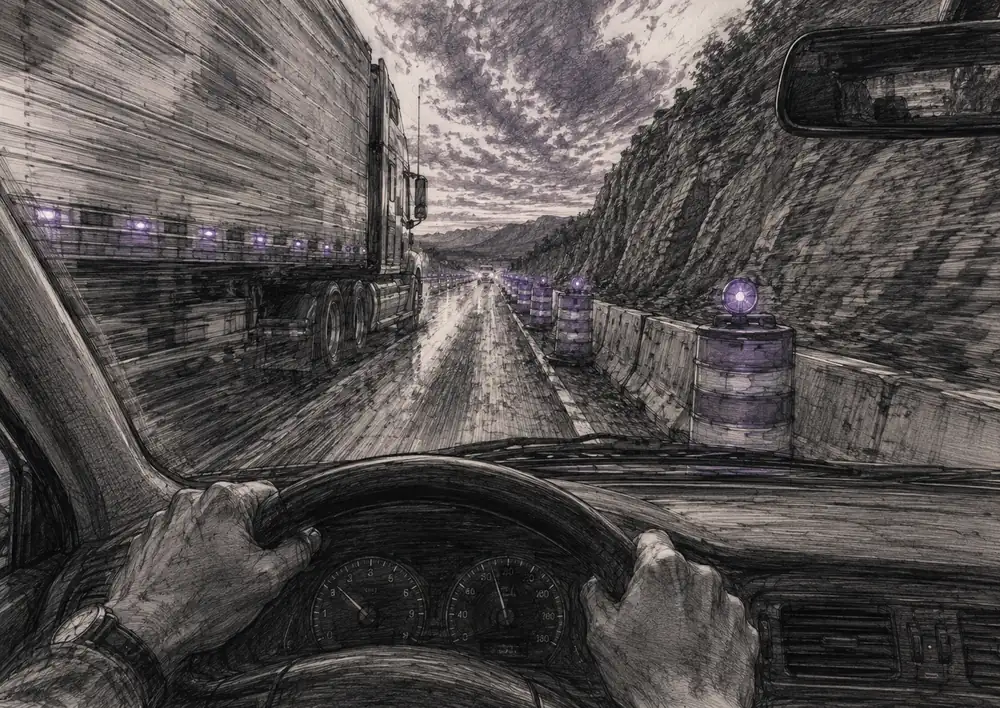
I could live like that for most of my life because I was the only one paying for it. I could be reckless and outrun my own bad decisions, and even when the decisions were good, there was a weightlessness to that life I've never found anywhere else. Once I started driving, I loved it. One feeling from all those miles has stuck with me more than any other: when construction narrows the highway down to one thin lane, and you're going so fast it feels like you're barely going to fit between the barrels, so you go through as an act of faith and hope the whole way. That's what those years felt like. I gave them up — the moving, the weightlessness, the risks I took just because I could — to give the kids more stability. The rewards went. The feeling didn't. Life doesn't feel any less like pressing the gas and hoping for the best than it did then.
But that risk tolerance belonged to a man betting only on himself. With kids in the van, the job is different: take gambles off the table before we leave. Lock down what can be locked down, and be honest about which longshots remain. Part of me still wants to show them what it looks like when the longshots come in. I don't know yet how much of that is wisdom and how much is the old cockiness.
The closer the plan gets to becoming real, the more my mind starts showing me every way it could fail. What happens when the van breaks down? What happens when the medical bill comes? What happens when the guaranteed income is guaranteed but still isn't enough? What happens when we're hundreds of miles from anyone we know and I'm the only adult who understands how close we are to the edge?
Those aren't reasons to abandon the plan, and they're not reasons to wait for a version of safe that's never coming. They're reasons to stop treating finance like the project we'll fix once everything else is ready. Finance can't remain a system powered by last-minute miracles. We're going — so before we do, every reserve we build, every option we line up, every way to stop moving without collapsing is one less thing riding on luck. Enough room that an ordinary problem stays an ordinary problem instead of becoming the step that takes us over the cliff. That work has to start making real headway now.
At the same time, I can feel another storm building. The burn-it-down part of me is rising against the system I work in, and I know that impulse — how righteous it feels, how quickly frustration turns into certainty that the only honest response is to walk away and let the whole thing burn behind me. I've paid for that impulse before. I can't afford to let it win again.
This time the math is worse. Ten years ago I was already too old and too far removed from my old careers to get back in. Dreams of returning to consulting, IT, or finance are less realistic now than driving for Uber or working at Home Depot — and last year I couldn't get a call back for a part-time job at any Home Depot. In Nomadland, picking up work at each stop looked easy if you wanted it, and the movie was honest about what that work was. I'm guessing the real version — hoping for a job while living out of a van — isn't always so full of hope and promise. It would be worse with two kids hiding in the van.
The job I sometimes want to escape is still the thing financing the escape. I don't get to mistake disgust for readiness, or call an impulsive exit brave when two young children would have to live with the consequences.
So the answer, for now, is the least dramatic one. Stay. Work. Build the margin. Keep preparing the kids and keep preparing myself.
Don't blow up the bridge before we've crossed it.