Google Almost Killed Us
A wildfire closure, a phone route toward Black Bear Pass, and a family pickup learning that possible and reasonable are not the same thing.
We were supposed to drive into Ouray the pretty way. That was the plan. Highway 550, the Million Dollar Highway, the road people actually mean when they say they're going to Ouray and want the full Colorado mountain experience. Curves, cliffs, old mining country, stupid beautiful views, the kind of drive where everybody in the car eventually gets quiet because the scenery is doing more work than conversation can.
But there were fires.
The road really was closed. That part wasn't Google being dramatic. The fire was close enough to 550 that the highway had a closure, and Ouray was staying open with a detour. That sounded reasonable in the abstract. Fires happen, roads close, mountain towns figure things out. This is Colorado, not a mall parking lot.
The trick is that "detour" can mean a lot of things. It can mean a few miles on a county road. It can also mean your phone routes a family pickup toward Black Bear Pass like you're entering a Jeep commercial against your will.
Guess which version we got.
Before Telluride, I'd already called it off in my head. Something about the route didn't feel right. It didn't feel like the sane way into Ouray. I asked Maylin to look it up, and she said it was clear, or clear enough, or gave me the kind of answer that meant I was supposed to stop being dramatic and keep driving.
This is why she got quiet later. Not innocent quiet. Marriage quiet. The kind where both people know exactly whose confidence helped put the family on the side of a mountain, but nobody's ready to hold court because the driver still has to keep the truck attached to the planet.
We came into Telluride on 145, and at first nothing seemed insane. Telluride is dangerous that way. It looks too beautiful to be part of a bad decision. You're driving through this gorgeous mountain town, everything expensive and pretty and tucked into the cliffs, and your brain keeps saying this must be fine, places this scenic don't suddenly become death errands.
The first warning was Tomboy Road. Google wanted to send us up it right from town, and even I could tell that was wrong. It looked too sketchy to be true. So I ignored it, kept driving through Telluride, and felt briefly smart about it. That's the part that gets me now. I dodged the first bad idea and then took the second one, like the app was running a con and Tomboy was only there to make the next route look reasonable. What I didn't understand yet is that there are no acceptable roads out the back of Telluride. Every option back there is a variation on the same dare.
So Google sent us out the back. Through town, past the parking area at Pandora Mill, onto County Road 648 and then something called K69, offered up like it was a normal thing to hand a family on their way to a hotel. The pavement gave up. The road narrowed. The grade changed. The switchbacks started to look less like turns and more like a dare scratched into the side of a cliff.
And we kept going.
That's the part I still don't fully understand. I was scared almost immediately, and not "this is a little spicy" scared. Real scared. The kind where your whole body starts quietly preparing evidence that you should've turned around three decisions ago. But there was no obvious place to turn around, not in a full-size pickup, not without some six-point reversal turning into a trip down the mountain the short way. So I did what terrified drivers do. I kept pretending one more turn would fix it. Maybe it clears up. Maybe the pass opens. Maybe this is the rough little section before the actual detour. Maybe I'm just being weak.
Google wouldn't send a family with a four-year-old and a two-year-old up a road that looks like it was designed by a mining mule with unresolved anger. That was my mistake. I kept assigning adult supervision to the app. Somewhere in my head there was still a person in there — a ranger, a local, a calm engineer in a vest who'd looked at our route and our vehicle and said, yeah, this is how people are getting to Ouray for the Fourth.
There was no person.
There was just a blue line.
The truck could probably do it, and that was part of the trap. We weren't in a sedan. We had four-wheel drive, clearance, a pickup. From the outside we probably looked like we had some kind of business being there.
We did not.
We had highway tires and kids in the back. We had no off-roading plan, no mountain-pass confidence, and no reason to be there except that the phone kept insisting this was a way. It may technically have been a way. That's not the same as being a road for me. There were no guardrails, no shoulder, no forgiveness. Just rock wall on one side and a drop on the other, with switchbacks tight enough that every turn felt like a small hearing about whether I'd ever been competent at anything in my life.
Raven, who is four, kept saying, "Dad, I don't really like driving up the mountain."
Same, kid. Same.
I was trying not to let the kids hear what was happening inside me, because what was happening inside me was mostly prayer and panic. I wasn't taking pictures. I wasn't soaking in the view. I was trying not to cry — not big dramatic crying, more like internal crying, system-failure crying, the kind where your brain is doing math it doesn't want to do. How much room do I have on the left? How loose is that rock? What happens if I slide? Could Maylin guide me if I had to back out? No. I couldn't trust that. Not because she wouldn't try, but because a marriage has limits, and one of mine is not handing my life to passenger-side cliff-distance estimates while my heart is trying to escape through my ears.
We passed hikers, which somehow made it worse. Hikers belong there. Hikers look at roads like that and think, "Beautiful." Jeep people belong there. They have tires the size of hot tubs and calm little radios and probably names for all their suspension parts. We looked like the Griswolds. A family pickup, highway tires, kids in the back, Dad silently bargaining with God, Mom not speaking because her earlier "it's clear" was still sitting in the cab like a live animal. Every hiker we passed had to know. They didn't say anything, but they knew.

The terrible thing is that it was beautiful. Bridal Veil Falls was right there, doing what waterfalls do, which is being magnificent at a completely inappropriate time. The old power station sat on the cliff like some haunted mountain mansion built by people who didn't believe in practical locations. The view opened up below us in that huge Colorado way, all rock and valley and sky, and I couldn't enjoy one inch of it. I was too busy surviving scenery. Other people see a waterfall. I see the fact that gravity's been undefeated for a very long time.
Then, finally, the road stopped helping Google lie to me. Past the Bridal Veil power station turnoff, close enough to the top for my blood pressure, the trail was closed. Actually closed. A barricade across the road, and a sign saying traffic was one-way, coming down from the other side. We were not going that way. Nobody coming up this road was ever going that way. That's the part I keep circling back to. The route had no resolution. It wasn't a longer, rougher path to Ouray that happened to be blocked. It was a dead end sold as a detour, and Google sent a family pickup up it anyway. What was the point? I still can't believe that was allowed to happen.
That barricade was one of the most beautiful things I've ever seen.
Not because it solved the problem. We still had to get down. We still had to turn around and drive back through every awful bit of road I'd just survived while pretending the story might turn out fine. But the barricade let me stop pretending. I didn't have to say I can't do this. The mountain said it for me. The county said it. The sign said nope, buddy, you're done — and because of that final switchback, I finally had enough room to turn the truck around without turning my family vacation into a news item.
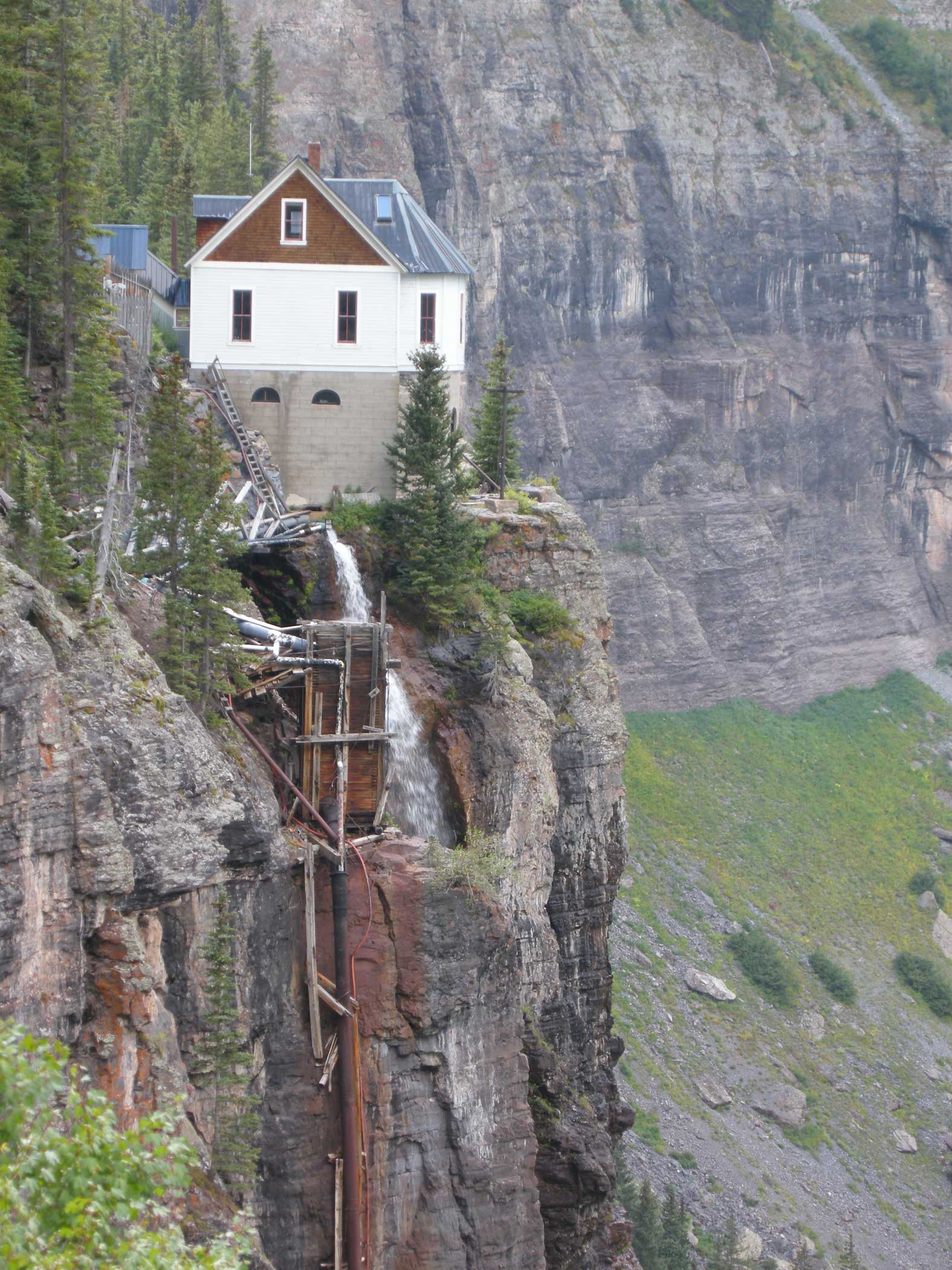
Then we had to go down. I don't know how long the descent actually took. Time gets weird when every tire placement feels like a moral decision. I know we passed some of the same hikers. I know the road looked impossible from the other direction — not because it had changed, but because I no longer had the excuse of believing the next turn might save us. On the way down I kept looking at it and thinking, how the fuck did I keep going this long? I must be crazy.
Eventually the road widened, the world got flatter, and Telluride became Telluride again instead of the gateway to my personal trembling. We got back to the regular roads, and at that point I was basically done — not with the detour, with the trip. I was ready to go home. Ouray could burn. Not literally, obviously, that was already too close to the actual issue. But emotionally I was prepared to cancel the whole thing. We'd tried, the mountains had rejected us, the family had survived. That felt like enough adventure for one holiday weekend.
Then we got back to Ridgway and stopped for gas, and the attendant said 550 was closed but the detour was easy.
I did not trust this woman. Not because she seemed unreliable. She was probably perfectly reliable. But my heart was still somewhere above Bridal Veil Falls, and "easy detour" had recently become a phrase with a lot of trauma attached to it. For all I knew, locals considered a vertical goat path "not that bad" as long as you didn't have to winch yourself out before dinner. Still, she said it plainly. The road was closed, yes. But the detour was easy.
So we tried again. Not with confidence. With the emotional energy of a man returning to a restaurant where he'd once been poisoned because someone at the counter said, "No, no, this sandwich is fine."
And the detour was fine. After all of that — Black Bear Pass, the switchbacks, the hikers, Raven politely announcing that she did not care for mountain death roads — the actual 550 closure detour was a mild little county-road situation. About three miles. Dirt, but good dirt. Maybe paved dirt, if that's a thing. Smooth enough, level enough, normal enough that it barely deserved to be called a detour. That was the thing Google had failed to get us to. A few harmless miles on a county road.
Then we got back on 550 and drove into Ouray, and that part was spectacular. On the way in you could see where the fire was working — the orange glow behind the ridges on the far side of the box canyon, smoke rising off it into the sunset until the whole sky went fire-orange. Not pretty-orange, actual burning-world orange. The sky looked lit from inside. But the wind was blowing away from town, so Ouray itself sat clear at the bottom of the canyon, calm and untouched, while the sky above it announced the emergency. It was beautiful the way disasters can be beautiful from the right side of the wind, which isn't a comfortable kind of beauty, but it's real.
We drove into town exhausted and grateful and still buzzing with leftover fear. I felt like a survivor of something I'd technically done to myself, which is the most annoying kind of survival. And the stay turned out to be wonderful. Once we got there, Ouray was exactly what we needed — walkable, relaxed, strange, full of water and cliffs and old mountain-town weirdness. The kids had fun. We settled in. The trip became a trip again instead of a driving emergency.
And the town was glad we came. Not in a hospitality-industry way. In a real way. There was a fire working behind the ridges and half their holiday traffic scared off, and everyone we met seemed genuinely grateful that people had shown up anyway. Then the Fourth of July parade made me proud to be American, and not in the yard-sign way. Just people treating each other well. The whole town cheering for the firefighters — the actual heroes keeping that orange glow on the far side of the ridge — and the firefighters looking half-embarrassed about it, the way heroes do. It was the same way in Montana. Up in those little mountain towns, everybody seems fine being American, fine being neighbors, fine being there. I'm tired of living in places that think this country sucks. Nobody in Ouray thinks that. They were too busy being grateful to the people saving their town.
But I'd also learned something about myself, and unfortunately it wasn't flattering. I'm out of practice. There was a version of me, a long time ago, that traveled loose. Not fearless, but looser. I could wander, adapt, get lost, figure it out. I've told myself that guy is still around somewhere, waiting for the slow-travel life to begin. Maybe he is. But apparently he doesn't live on Black Bear Pass. That guy has been softened by age, kids, mortgages, school schedules, bad knees, and the knowledge that one dumb decision now comes with car seats in the back. I don't need to be an off-road guy. I can say that with peace in my heart. I saw where that road goes.
It goes straight through my nervous system.
On the drive home, Google kept trying. It wanted reroutes that weren't required and weren't smart, little detours off perfectly good highway, and after Black Bear Pass I wasn't taking suggestions anymore. We ignored the app and drove the roads we could see, watching the little blue dot follow us for once instead of the other way around.
So yes, maybe the title is dramatic.
But not as dramatic as that road.
A note on the photos: they're not mine. You can see Telluride from up on that road, and the view is amazing — I already knew that, because I hiked up there thirty years ago, back when climbing that valley sounded like a good time instead of a lawsuit. But on this trip, the last thing on my mind was let's get a photo. So the photos here are real images of the area, used with credit and license notes. They are not pictures of our truck, our family, or the exact moment I was trying not to cry.