Straight Greats No. 2: Aerosmith Had Six
Aerosmith's first six albums all clear the line. The last two only felt like letdowns because the first four had made the band an eleven-year-old's main connection to rock and roll.
STRAIGHT GREATS
SIX STRAIGHT
☠☠☠☠☠☠ 6 CERTIFIED
Aerosmith
Aerosmith · Get Your Wings · Toys in the Attic · Rocks · Draw the Line · Night in the Ruts
Straight Greats is the series for artists who put together runs of nearly perfect albums, one after another. Some make it to three. A few go further. The point isn’t whether every sane person on earth has to agree. The point is that a run holds up start to finish, album after album, with no dead weight and no charity required.
This one gets six certified skulls: Aerosmith, Get Your Wings, Toys in the Attic, Rocks, Draw the Line, and Night in the Ruts. All six clear the line clean.
I originally stopped at four. Then, while applying the new rating system, I almost put Draw the Line on the edge. That was wrong too. I was still grading the last two albums against the four records in front of them instead of grading them against the actual line.
The last two aren’t as good as the first four. That isn’t the same as not being great. If you heard Draw the Line and Night in the Ruts without knowing the band was coming apart, you wouldn’t hear two records that needed charity. You’d hear a great rock band that had finally stopped winning the World Series every year.
No asterisk. No mercy ruling. Six albums, all good from beginning to end. And because this is now official, Aerosmith may fill out the contact form to claim its badge.
The six albums came out in less than seven years:
- Aerosmith — 1973
- Get Your Wings — 1974
- Toys in the Attic — 1975
- Rocks — 1976
- Draw the Line — 1977
- Night in the Ruts — 1979
Three would have been enough. Four was showing off. Six requires an explanation.
Aerosmith — 1973
The first Aerosmith album sounds different from the three that followed it. The production is thinner, Steven Tyler doesn’t completely sound like the Steven Tyler everybody came to recognize later, and the band is still working out exactly what it is.
You can hear some of the groups people accused them of copying. There’s some Rolling Stones in there, some Zeppelin, and a lot of the blues rock every hard-rock band was pulling from at the time.
But the album doesn’t qualify because of what Aerosmith would become later. It qualifies because the songs are already there.
“Dream On” appears as the third song on the first Aerosmith record, which is almost ridiculous when you think about it. Most bands don’t have a song that big anywhere in their career. Aerosmith had it sitting on side one of its debut.
That song can also distort the way people remember the album. “Dream On” becomes the whole story, and everything else turns into the place where Aerosmith happened to put it. But “One Way Street” lets the band stretch into its bluesier side, “Mama Kin” may be the first song where the complete Aerosmith personality appears all at once, and “Movin’ Out” already sounds like the band knows where it wants to go even if it hasn’t figured out how to make the records sound as big as the songs yet.
The roughness helps. Aerosmith still sounds like a band playing in a room, trying to prove it deserves another record.
People can reject the debut if they want. That still leaves five straight albums from Get Your Wings through Night in the Ruts.
I’m keeping the first one.
Get Your Wings — 1974
On Get Your Wings, Aerosmith becomes Aerosmith.
“Same Old Song and Dance” and “Lord of the Thighs” open the record, and the difference is immediate. The band sounds darker, heavier, stranger, and much more confident. The first album introduced the pieces. This one locks them together.
“Spaced” is one of my favorite Aerosmith songs. It sounds strange and slightly unsteady, as if it’s floating somewhere outside the rest of the album while still being completely part of it.
Then the second side starts: “S.O.S.,” “Train Kept A-Rollin’,” “Seasons of Wither,” and “Pandora’s Box.” That may be the strongest complete album side Aerosmith ever recorded.
“Train Kept A-Rollin’” sounds like the band discovering how hard it can push, while “Seasons of Wither” goes in the other direction. It’s heavy without pounding on you, dark and slow and huge, almost as if the song is arriving through bad weather. Aerosmith became famous for loud singles and giant choruses, but some of its best work came when it let the atmosphere do part of the job.
Get Your Wings doesn’t have a “Dream On”-sized hit sitting in the middle of it. It doesn’t need one. This is the album where the band itself becomes the reason to listen.
Toys in the Attic — 1975
Toys in the Attic is where Aerosmith became enormous.
The title track, “Walk This Way,” and “Sweet Emotion” are so familiar that they can make the album seem obvious. “Walk This Way” became bigger than Aerosmith and then became enormous all over again when Run-DMC helped drag both the song and the band into another era. “Sweet Emotion” became one of those songs that can begin playing anywhere and immediately change the room.
But the songs around the hits are why the album belongs here.
“Uncle Salty” is weird and unsettling. “Adam’s Apple” has the swagger people think of when they think of Aerosmith. “Round and Round” is heavier and uglier than the famous songs surrounding it, and “You See Me Crying” closes the record with a full dramatic ballad before Aerosmith ballads became their own division of the music industry.
Then there’s “No More No More,” which may be one of the best songs they ever recorded. It has everything that worked about the band before the machinery around it became too large: the guitars, the movement, the arrogance, the exhaustion, and the feeling that this is all probably going to fall apart eventually, but not tonight.
Toys in the Attic made them stars, but it doesn’t sound like a band protecting its new position. It still sounds hungry.
Rocks — 1976
Then came Rocks.
I can still feel the opening of this album before I hear the song. That strange noise starts building, the bass comes in underneath it, and “Back in the Saddle” begins moving toward you.
There are records you remember liking, and there are records where some physical part of the original reaction remains inside you. Rocks is one of those for me.
The whole album feels hard, dirty, and slightly dangerous. “Last Child” slows things down without losing any of the force. “Rats in the Cellar” sounds like Aerosmith answering its own “Toys in the Attic” with something faster and less controlled. “Combination” gives Joe Perry more room and feels like somebody else inside the same damaged building getting a turn to speak.
Then there’s “Nobody’s Fault,” which may be the heaviest song Aerosmith ever recorded. It sounds genuinely threatening. Not theatrical-dangerous or music-video dangerous. It sounds as though something has gone badly wrong and nobody is getting out clean.
There isn’t a weak song on Rocks. There isn’t even one that needs to be defended as important to the atmosphere. Every track works, and every track belongs where it is.
People used to dismiss Aerosmith as an American version of the Rolling Stones or as a band borrowing whatever it could from Zeppelin. The visual comparison with the Stones was obvious: the skinny, big-mouthed singer and the dark, dangerous-looking guitarist standing beside him. The heavy blues influence gave critics the rest of the argument.
There are worse things for a young band to resemble.
But by Rocks, Aerosmith didn’t sound like an American copy of anybody. It sounded like Aerosmith, and nobody else sounded quite like that.
It’s also where I came in.
Draw the Line — 1977
Without the internet, it was surprisingly easy not to know that a band had a new album coming. There wasn’t a release date following you around for three months. Sometimes you heard a song on the radio first. Sometimes somebody told you. Sometimes you walked into a department store and there it was in a display.
That’s how I found Draw the Line. I’m pretty sure I was in eighth grade. We were at a big department store in a mall, I saw the new Aerosmith album, and I begged my dad for the money to buy it.
I took it home expecting another Rocks.
That was the problem.
The title track comes tearing out of the speakers. “I Wanna Know Why” is Aerosmith doing exactly what I wanted Aerosmith to do. “Kings and Queens” is darker and stranger, “Sight for Sore Eyes” has the swagger, and “Milk Cow Blues” lets them go back to the material underneath everything they had built.
It was a strong record. It just wasn’t the fifth impossible record in a row.
At the time, that felt like a letdown. Looking back, it was like watching a team win the World Series four years in a row and then feeling disappointed because it only won the division the next year. The drop-off is real. So is how ridiculous the standard had become.
Draw the Line doesn’t need to be as good as Rocks to be Certified. It has to hold up from beginning to end without a track I need to excuse. It does.
This is where the band’s collapse starts becoming part of the story. If you know what was happening, you can listen for the damage. If you don’t know, it still sounds like a great rock band making a very good record.
Certified.
Night in the Ruts — 1979
In between came Live! Bootleg, which gave me another full dose of the band I had connected with in the first place. Then Night in the Ruts showed up when I was in ninth grade, and I bought that one when it came out too.
By then, the situation felt different even if I didn’t have all the information. Joe Perry left while the album was being finished, but there was no internet delivering daily reports from inside Aerosmith. Mostly, you knew what the album sounded like, what the radio chose to play, and whether anybody around you seemed to care.
Columbia made “Remember (Walking in the Sand)” the single, which pissed me off. I liked the song. That wasn’t the issue. It just wasn’t freshman-in-high-school cool, and it wasn’t the song you wanted representing Aerosmith when you were trying to believe the band was still dangerous.
Nobody was really mocking the album. Nobody was raving about it either. It arrived, I bought it, and the sense that Aerosmith was moving backward got a little harder to ignore.
But that’s the story around the record. The record itself is better than the story.
“No Surprize” and “Chiquita” open it hard. “Three Mile Smile,” “Reefer Head Woman,” and “Bone to Bone” all sound like Aerosmith, not a damaged imitation of Aerosmith. “Think About It” is one of my favorites on the album.
Then there’s “Mia.” I wasn’t automatically drawn to the slow song just because it closed an Aerosmith record. Even “Home Tonight” wasn’t the part of Rocks I was putting on to prove something. But “Mia” works. It sounds beautiful and exhausted at the same time, which turned out to be a pretty accurate place for the original band to end.
If I didn’t know Aerosmith was falling apart while it made Night in the Ruts, I’m not sure the album would tell me. It sounds more focused than the circumstances had any right to produce. Every song belongs, and the whole record moves.
It isn’t Rocks. Almost nothing is.
Certified.
What it created for me was a different problem: What do you do when your main connection to rock and roll is going backward?
Before Aerosmith
I didn’t have an older brother or sister bringing records home and telling me what I was supposed to like. My mom had to provide the starting point.
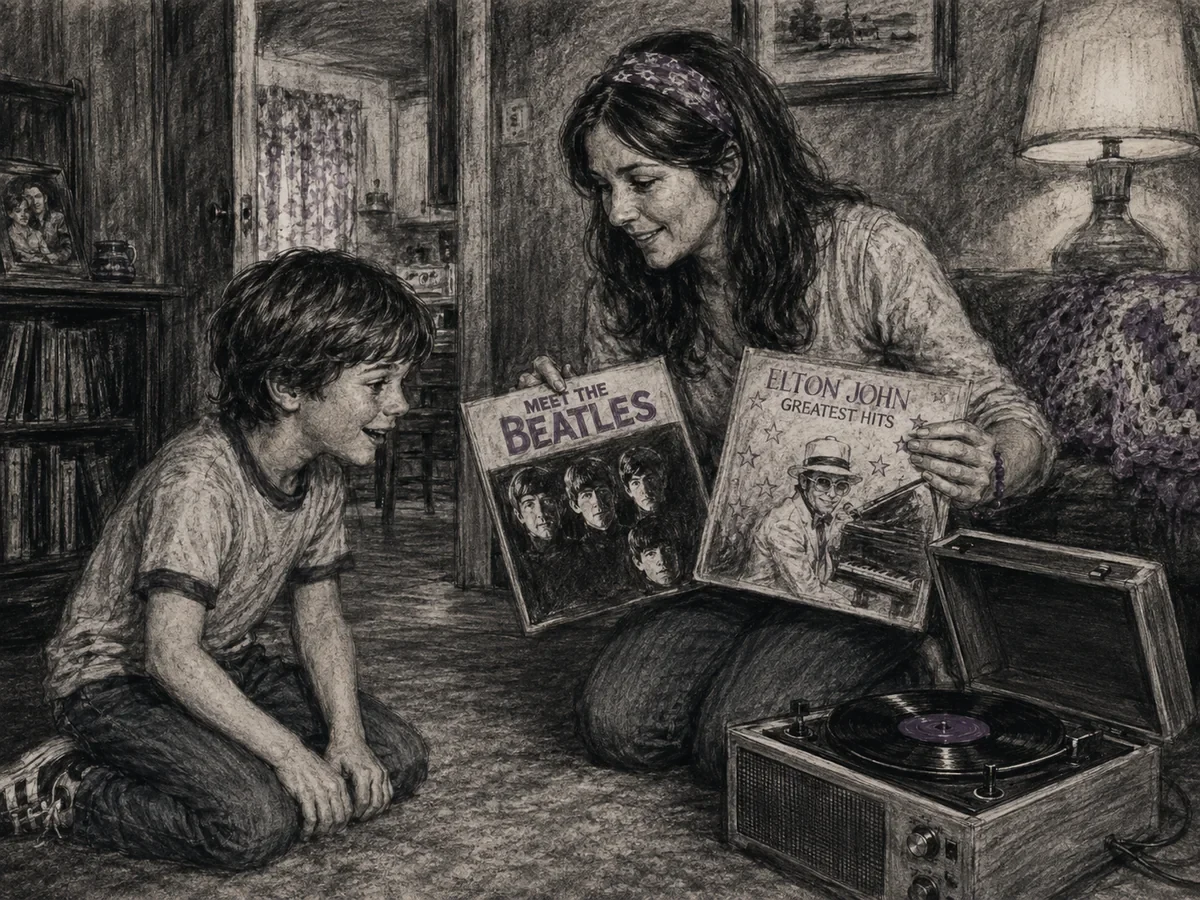
When I was in third grade, she bought me two albums: Meet the Beatles and Elton John’s first Greatest Hits.
She was probably getting close to forty by then and, as it turned out, had listened to plenty of jazz and other music. But she didn’t know much about the current rock music an eight- or nine-year-old boy might be expected to want. She apparently knew enough to choose the Beatles and Elton John, though, which was a pretty impressive pair of blind guesses.
Those records weren’t necessarily pointing directly toward everything I would eventually listen to. They were just a very good doorway.
I played them constantly on a little one-piece phonograph with the speaker built into it. It wasn’t exactly high fidelity. You put the record on top, lowered the needle, and the sound came out of the same plastic box.
That was enough.
Those two albums introduced me to the idea that a record wasn’t just the song you heard on the radio. It was a whole object you could own and play until every part of it became familiar.
They got me started. After that, I began finding the rest for myself.
Bilotti’s Shoe Repair and Record Store
The first Aerosmith record I owned was the “Dream On” single.
I hadn’t caught it the first time around. Aerosmith released the song in 1973, when I was still pretty young. It was rereleased near the end of 1975, after the band had become much more successful, and that was when it finally became a major hit.
By then, I had started buying records myself.
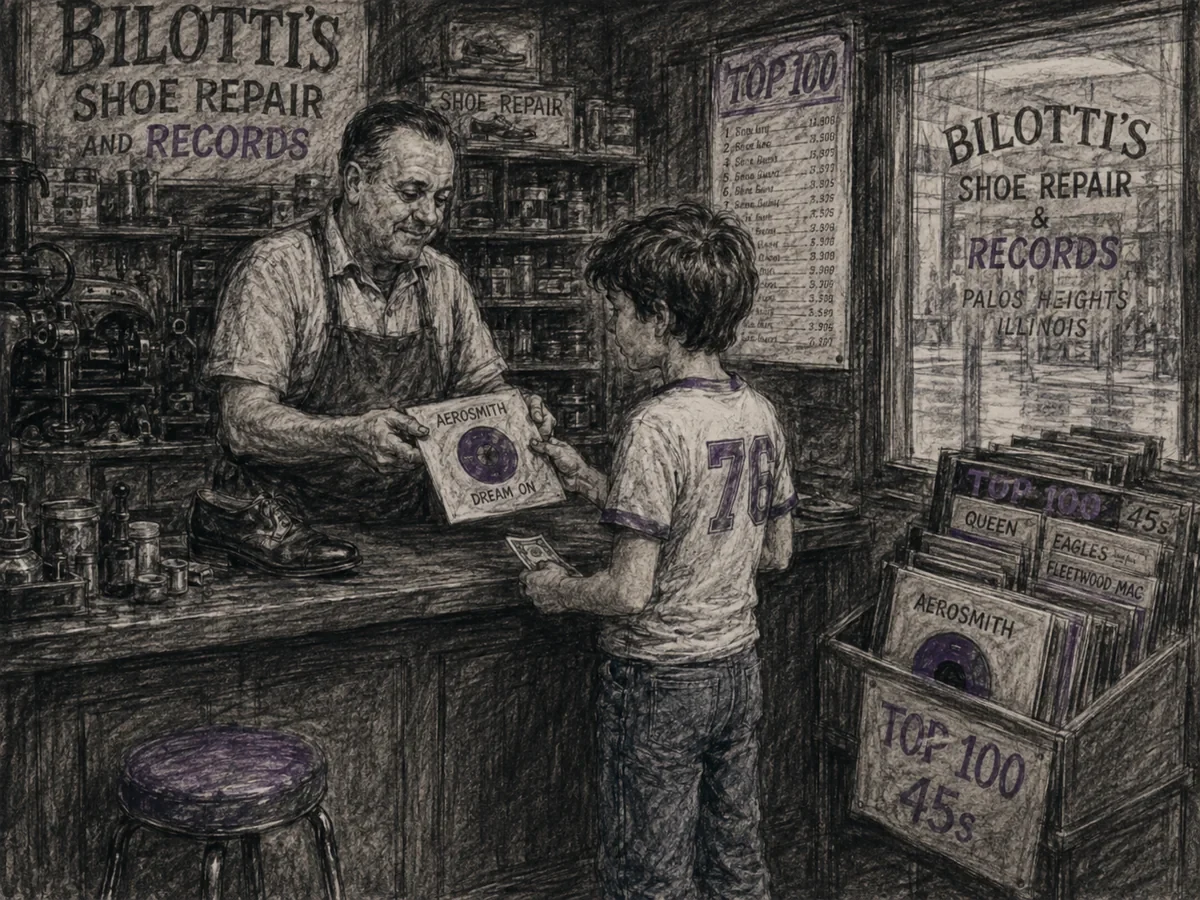
There was a shoe-repair shop about a mile and a half from our house called Bilotti’s in Palos Heights, Illinois. It was part of one of those little neighborhood collections of stores that existed before nearly every errand took you into a national chain.
For some reason, Bilotti’s also sold the current hit singles. That apparently made perfect sense.
There was a printed chart sitting on the counter with the top records listed on it. You’d look at the list, tell the guy which single you wanted, and he’d get it for you. He didn’t sell albums. He sold 45s.
You weren’t really browsing. You already knew what you wanted because you’d heard it on the radio. The chart gave you the name and probably helped you figure out which songs were actually available. Then you bought the little record and carried it home.
The albums from my mom had shown me what records could be, but Bilotti’s was where buying music became mine. I was listening to AM Top 40 radio and starting to move into the album-rock stations on FM. When I heard something I liked, I wanted to own it as soon as I could collect enough money and walk to the store.
“Dream On” was one of the singles I brought home.
That’s difficult to explain to kids now. Every song ever recorded is already sitting on the same device they use to play games and send messages. You don’t have to hear something on the radio, remember what the announcer said, find a store that carries it, walk there, check the chart, spend your money, and walk back holding one song.
We did a lot of work to hear the same song again.
The Stereo and Rocks
By sixth grade, I had decided that I needed my own stereo.
I didn’t merely think it would be nice to have one. I wanted it desperately. I would go back to the store and look at it while I was still saving, checking on it as if somebody else might discover that it was mine and take it home before I could get there.
I saved money from cutting lawns, delivering newspapers, and whatever other small jobs I could find. The stereo cost somewhere around $300. Adjusted for inflation, that would be roughly $1,750 now.
I was eleven years old.
I have trouble imagining an eleven-year-old today being willing to save $1,750 for a stereo. I have trouble imagining most eleven-year-olds wanting any one thing badly enough to keep working and saving while going back to stare at it every week.
For me, it was everything.
Malls had stereo stores then. Not an electronics aisle inside a giant store. The entire store was stereos.
They carried everything from lower-end systems an eleven-year-old could at least imagine buying through higher-end equipment that looked impossibly expensive and complicated. You could walk around looking at turntables, receivers, speakers, and systems stacked in cabinets, imagining what all of it would sound like in your room.
The system I bought had a turntable on top, an 8-track player, an AM/FM radio, and two detached speakers.
When I went in to buy it, Rocks had just come out. The album seemed to be everywhere in the store. I already owned the “Dream On” single and knew some of the songs from Toys in the Attic through the radio, but I didn’t really know the albums yet.
I bought Rocks with the stereo, took them both home, and played that record until it became the sound of the new system and the reason I’d needed the system in the first place.
Within about a month, I bought the first album, Get Your Wings, and Toys in the Attic. I didn’t experience this run the way somebody following Aerosmith from the beginning would have. I didn’t wait a year between each record and hear the band change gradually.
I entered through album four and worked backward. The entire run landed on me almost at once, and those records have always felt less like four separate releases than one enormous block of music.
Ten Dollars in an Envelope
I liked Aerosmith enough that I joined the fan club.
Aero Force One.
This was when joining a fan club meant finding an address in a magazine or an album insert, putting about ten dollars into an envelope, and mailing it away. Then you waited.
Eventually, something would arrive. There’d be a newsletter, some stickers, perhaps a patch, and a merchandise sheet showing other things you could buy by sending more money through the mail.
I remember Billie Perry, Joe Perry’s wife at the time, being connected with running it, although that’s one of those details I’m not willing to bet the house on fifty years later. The rest of it I remember clearly: the mail, the newsletters, the patches, the order forms, and the excitement of getting an envelope that had something to do with the band.
There was no login, no instant confirmation email, and no online store showing you where your package was.
You sent your money into the darkness and trusted Aerosmith.
The good old days.

The Loyalty Those Albums Bought
That question had started before the original lineup completely fell apart. Aerosmith had become my main connection to rock and roll, and now the band seemed to be moving in the wrong direction. I didn’t stop caring. I started learning how much bad news six great albums could survive.
I saw Aerosmith many times, but by the time I was old enough to go to concerts regularly, I had missed the band at its most dangerous and probably its best.
The original version was falling apart. The drugs and damage were catching up with everybody. Joe Perry left. Brad Whitford left. The band kept going, but the wheels were coming off.
Then the original lineup came back together and eventually rebuilt the entire operation with Permanent Vacation and Pump. I saw those tours too.
That version of Aerosmith was good. Sometimes it was very good. Those were real comeback albums, not just record-company attempts to convince everyone the band mattered again.
But it was a different Aerosmith.
The records were cleaner. Outside writers and MTV became part of the process. The ballads kept getting larger until Aerosmith almost became two bands: the old hard-rock band and the company that manufactured enormous Aerosmith ballads.
I kept going to see them anyway.
Those first six albums had purchased a nearly unlimited amount of loyalty from me. The first four created it. Draw the Line and Night in the Ruts tested it without breaking it. Later, I defended records more than they deserved. I found the good songs and ignored some of the others. I kept giving the band another chance because the group that made Get Your Wings, Toys in the Attic, Rocks, and even those two records while it was coming apart had to still be in there somewhere.
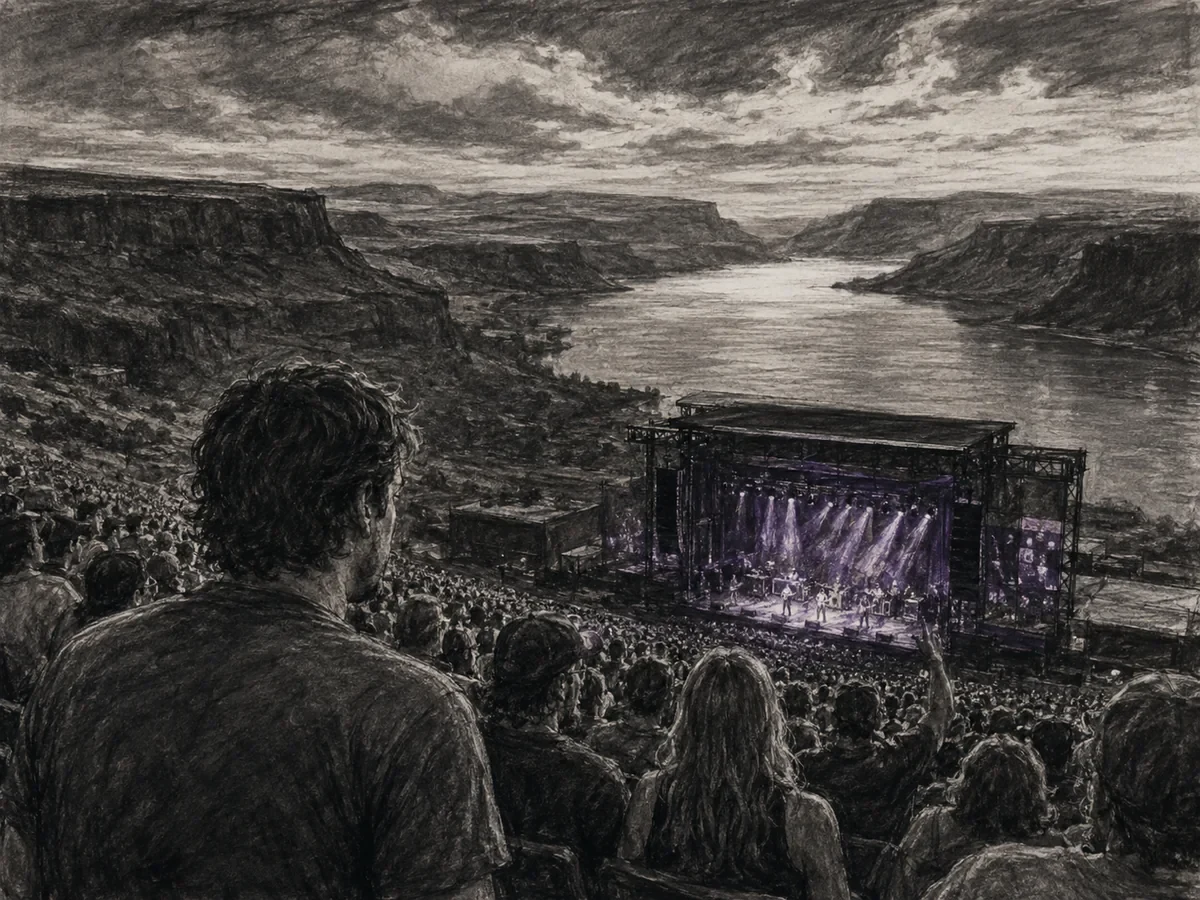
The best Aerosmith show I ever saw came surprisingly late. It was at the Gorge in Washington in August 2001.
The Gorge barely looks like a real concert venue. The stage sits in front of the Columbia River and all that open land, and the view behind the band is so enormous that the concert almost seems like it was set up in the middle of the landscape by accident.
Aerosmith was amazing that night. Not good for an old band. Not impressive considering how long they’d been doing it. They were just great—better, in some ways, than the younger versions I’d seen when the band was less reliable and considerably less healthy.
It felt like one last huge burst of energy from the real thing.
Only a couple of years later, I saw Aerosmith again on the double bill with KISS. Seeing those two bands together should’ve been the greatest event the sixth-grade version of me could possibly imagine.
It wasn’t.
By then, Aerosmith felt less like Aerosmith and more like the Aerosmith attraction. The songs were there. The people were mostly there. All the recognizable pieces were being presented in the right order, but something was missing.
Only two years separated that show from the Gorge, which made the difference even stranger. At the Gorge, they had seemed completely alive. On the KISS tour, it felt more like two giant pieces of rock history had been rolled into the building so everyone could take a look.
I still went.
This Isn’t the “Pink” Aerosmith
Someone looking for “Pink” or the run of giant Aerosmith ballads from the 1990s isn’t going to find that band on these records.
That isn’t automatically an insult to everything that came later. Aerosmith made good music after Night in the Ruts, and the comeback itself was remarkable. Most bands that fall apart as completely as Aerosmith did don’t get another real act. Aerosmith got several.
But the first six albums are a different thing. The first four are the peak. The next two are the sound of a great band losing its grip without yet losing the ability to make a great record. This is Aerosmith before it learned how to make an Aerosmith product—before the videos, the professional song doctors, the movie ballads, and the giant tours built around reminding everyone that Aerosmith was Aerosmith.
Those first six records bought the band more loyalty from me than the rest of its career had any right to expect.
I kept paying them back for another thirty years.
Does Aerosmith get all six for you, or does the run stop after Rocks? Let us know through the contact page.